

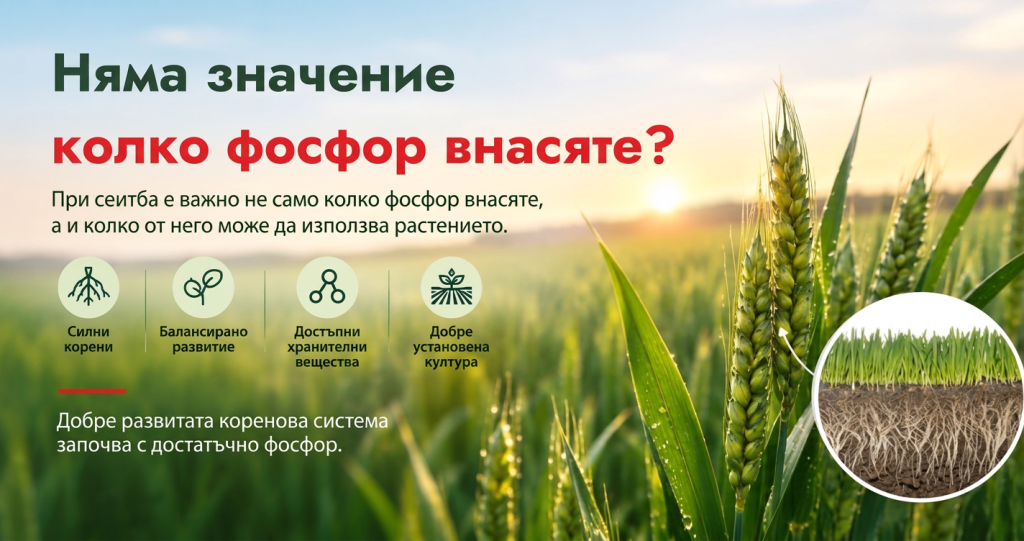
As germination begins and the first roots emerge, the crop enters a stage in which access to soil nutrients becomes essential for successful establishment. Phosphorus plays an important role during this period, as it is involved in processes that support early growth and root-system development.
In practice, however, the mere presence of phosphorus in the soil—or the application of a phosphorus fertiliser—does not automatically mean that plants can use the entire amount. Soil pH, soil characteristics, moisture, temperature and root development all influence a crop’s access to this nutrient.
That is why, when fertilising autumn crops, the relevant question is not only “how much phosphorus do we apply?”, but also “how much of this phosphorus can the plant access under the specific conditions of the field?”
- What role does phosphorus play at the start of vegetation?
Phosphorus contributes to essential plant-development processes and is particularly relevant during crop establishment. It is involved in energy transfer and energy use within the plant—processes on which young-tissue growth and root-system development depend.
For farmers, the implication is practical: during the early stages, the plant needs to develop a root system capable of exploring the soil and accessing the water and nutrients required for subsequent growth.
For autumn cereals such as wheat and barley, phosphorus nutrition must also be considered in the context of crop establishment and tillering. During this period, the foundation for vegetative development is formed before the crop enters the cold season.
However, this relationship should not be reduced to the idea that “more phosphorus means better development.” The level of the nutrient in the soil matters, but so do the form in which it is present and the roots’ ability to access it.
In brief: Why is phosphorus important at the start of vegetation?
Phosphorus contributes to processes that support the early development of the plant and its root system. In autumn cereals, adequate phosphorus nutrition is also relevant for crop establishment and tillering. Its effectiveness, however, depends on the amount of phosphorus that roots can actually access from the soil.
- Why does root development matter so much?
A well-developed root system allows the plant to explore a larger volume of soil and, consequently, gain access to more water and nutrients in the root zone.
In the case of phosphorus, this is particularly important because the nutrient has low mobility in the soil. Unlike more mobile nutrients, phosphorus moves only over short distances, so roots must reach the areas where it is available.
At the beginning of vegetation, this creates a challenge: roots are still poorly developed and explore only a limited soil volume, precisely during a period when the plant needs nutrients to continue developing its root system.
Access to phosphorus also depends on field conditions. Soil that restricts root development, as well as unfavourable moisture conditions, can limit the volume of soil explored and, therefore, access to nutrients.
This is why root development and phosphorus availability should be assessed together rather than separately.
- Applied phosphorus vs. available phosphorus: what is the difference?
The amount of phosphorus applied is not the same as the amount the plant can absorb. After application, phosphorus can enter into different reactions with soil components, and part of it may convert into forms that are more difficult for roots to access.
The difference is important:
- Applied phosphorus is the amount introduced into the soil through fertilisation.
- Available phosphorus is the share found in a form and soil zone from which plant roots can access it.
Phosphorus has low mobility and tends to react with various soil components. For this reason, two fields receiving the same amount of phosphorus will not necessarily have the same nutrient availability for plants.
Soil properties, pH, moisture and root development can all influence this relationship. This is precisely why soil analysis is the starting point for a fertilisation strategy tailored to the field.
| What to assess | Why it matters for phosphorus |
| Soil analysis | Shows the field’s starting situation |
| pH | Influences phosphorus reactions and availability |
| Soil characteristics | May affect how phosphorus reacts in the soil |
| Moisture | Influences root access to nutrients |
| Root system | Determines the volume of soil explored |
| Crop | Has its own development and nutrient-uptake dynamics |
Therefore, assessing phosphorus fertilisation solely according to the amount applied provides only part of the picture.
- How does pH affect phosphorus availability?
pH affects phosphorus reactions in the soil and, consequently, how much of the nutrient remains in a form accessible to plants.
In acidic soils, phosphorus can react with iron and aluminium and form compounds that are more difficult to access. Under alkaline conditions, reactions with calcium may also occur, reducing phosphorus availability.
The implication for farmers is important: the fact that an analysis indicates the presence of phosphorus in a field does not automatically mean that the crop can use the entire amount.
For this reason, pH should be interpreted together with soil-analysis results and with the specific characteristics of the crop and field. Adjusting pH or establishing a fertilisation strategy should be based on the farm’s actual conditions, rather than on a universal threshold.
- What influences phosphorus availability in soil?
Several factors act simultaneously on the way plants can use phosphorus:
- Soil pH – influences phosphorus reactions with different soil components and therefore its availability.
- Soil type and characteristics – texture, mineralogy and other properties can influence how phosphorus is retained and released.
- Existing phosphorus level – soil analysis helps establish the starting point and avoids fertilisation decisions made without field-specific information.
- Moisture – water contributes to nutrient transport towards the root surface, while moisture conditions also influence root-system activity.
- Soil temperature – may affect soil processes and root activity, with consequences for nutrient access.
- Root development – the more efficiently the root system explores a larger soil volume, the more likely it is to reach zones where phosphorus is available.
- Application method and timing – fertiliser placement and the conditions at the time of application can influence subsequent root access to the nutrient.
None of these factors should be considered in isolation. Phosphorus availability results from the interaction between soil, plant, climate and the applied fertilisation technology.
- Wheat, barley and rapeseed: what should you monitor in the early stages?
Winter wheat
After emergence, attention should focus on uniform crop establishment, root development and leaf-area formation. Tillering follows later and is an important stage in cereal development.
During this period, phosphorus access should be assessed in the context of root-system development and soil conditions. The fertilisation strategy should be based on field analysis, pH, fertilisation history and crop requirements.
Winter barley
For barley, the autumn objective is also proper crop establishment, but the strategy should not automatically be copied from wheat.
Uniform emergence, root development and the beginning of tillering before winter are key aspects to monitor. Phosphorus availability should be evaluated in relation to these processes and to the field’s specific soil conditions.
Rapeseed
In rapeseed, the autumn period is important for plant establishment and root-system development before the crop enters the cold season.
Nutrient access should be correlated with crop and soil condition, while the fertilisation strategy must be adapted to the field. The need for additional phosphorus fertilisation cannot be determined based solely on the crop, without information on nutrient levels and field conditions.
- How do you know whether a field needs phosphorus?
The decision should begin with soil analysis and should be correlated with the crop, field history and farm objective.
Not every field planted with wheat, barley or rapeseed automatically needs the same phosphorus fertilisation. Soil analysis provides information about phosphorus levels and pH, and these results should be considered alongside fertilisation history and the previous crop.
The production objective also matters, but it should be realistic and aligned with the field’s potential. If other limiting factors are present, simply increasing the supply of one nutrient does not guarantee that the plant will be able to make efficient use of it.
Before establishing a phosphorus fertilisation programme, check:
- What does the soil analysis show?
- What is the field’s pH?
- Which crop is going to be established?
- What crop was grown previously?
- What phosphorus fertilisation has the field received in the past?
- What is the soil condition and moisture level?
- What is the realistic production target?
- Are there factors that may limit phosphorus availability?
Considered together, this information helps build a strategy that is closer to actual farm conditions and avoids fertilisation decisions based solely on a general scheme.
- Why is it not enough to focus only on the amount of phosphorus applied?
The efficiency of phosphorus fertilisation should not be assessed only by the amount of nutrient introduced into the soil, but also by the conditions in which it can remain available and be used by the crop.
From a farm-management perspective, the distinction is important. Investment in a fertiliser should be assessed not only according to the amount of product applied per hectare, but also in the context of the soil, crop and fertilisation technology.
A larger amount of phosphorus does not automatically solve an availability problem. If pH or other soil characteristics encourage phosphorus to shift into less accessible forms, or if root development is restricted, simply increasing the application rate is not in itself an efficiency strategy.
This is why phosphorus management requires moving from the question “how much should I apply?” to a more complete approach: what is already present in the soil, what does the crop require, and under which conditions can the plant use the nutrient?
- Where does Nutri-Top technology fit in?
In the context where part of the applied phosphorus can become more difficult for plants to access due to reactions occurring in the soil, technologies have been developed to protect this nutrient.
Within the CICh portfolio, Nutri-Top is a range of phosphorus-based or complex fertilisers containing a polymer for phosphorus protection.
The role of such technology should be considered in relation to the agronomic challenge described above: managing phosphorus availability and making more efficient use of applied nutrients.
However, integrating Nutri-Top into a fertilisation programme does not replace soil analysis or the assessment of crop requirements. The formula and application strategy should be selected according to the crop, field characteristics and farm technology, together with the appropriate technical recommendation.
Common misconceptions about phosphorus
“If the soil contains phosphorus, the crop can automatically use it.”
Not necessarily. The presence of a nutrient and its availability to roots are two different things. pH, soil characteristics and conditions in the root zone can influence the plant’s access to phosphorus.
“Applying more phosphorus automatically means better nutrition.”
No. The rate should be determined according to soil analysis, the crop being established and field conditions. Additional application does not guarantee that the nutrient can be used by the plant.
“Phosphorus behaves the same way in every soil.”
No. Soil properties and pH influence phosphorus reactions and its availability to roots.
“The same phosphorus fertilisation is suitable for all crops.”
No. Wheat, barley and rapeseed have different development dynamics, and the strategy must be adapted to the crop and the specific farm situation.
Available phosphorus is what matters to the plant
During the early stages of vegetation, it is not enough for phosphorus to simply exist in the soil. In order to be used, the nutrient must be available in the zone where young roots can access it.
This is why a fertilisation strategy begins with understanding the field: soil analysis, pH, fertilisation history, crop and field conditions. Only then can the appropriate solution be determined.
Through technological fertilisers and technical advice, CICh aims to support farmers in developing strategies adapted to on-farm conditions, with a focus on the efficient use of nutrients.
Would you like to establish a fertilisation strategy tailored to your crop and the conditions of your field? Speak with the CICh team about solutions for phosphorus protection and efficient phosphorus use.
Frequently asked questions about phosphorus and autumn crops
Why is phosphorus important for winter wheat?
Phosphorus is involved in important processes for early growth and winter-wheat root-system development. During autumn, it is relevant for crop establishment and should also be considered in the context of tillering. However, what matters is not only the amount present in the soil, but also the fraction that roots can actually access.
When does the plant need phosphorus the most?
Access to phosphorus is important from the earliest stages of vegetation, when the root system is developing and the volume of soil explored is limited. However, nutrient requirements and uptake dynamics differ depending on the crop and growing conditions. Therefore, no universal application timing should be established without assessing the field situation.
How does pH affect phosphorus availability?
pH influences the reactions of phosphorus with different soil components. Under certain conditions, it can form compounds with iron, aluminium or calcium, becoming more difficult for roots to access. For this reason, pH is one of the indicators that should be assessed when establishing a phosphorus fertilisation strategy.
If soil analysis shows phosphorus, is fertilisation still necessary?
The need for fertilisation cannot be determined solely from the fact that the analysis indicates the presence of phosphorus. The available level shown by soil analysis, crop, pH, fertilisation history, previous crop and realistic production objective must all be considered. The recommendation should be established for the specific field.
What is the difference between applied phosphorus and available phosphorus?
Applied phosphorus is the amount of nutrient introduced into the soil through fertilisation. Available phosphorus is the share found in a form and a soil zone from which plant roots can access it. The two amounts are not necessarily identical, because phosphorus may react with different soil components after application.